

 Bildrechte: NLWKN
LIFE-Projekt „RePeat“
– Restoration of peatlands in the Hannover Region –
The LIFE+ project ‘Hannoversche Moorgeest’ is nearing a successful conclusion. The state of Lower Saxony and the Hannover region agree: The peatland-rich north of the Hannover region requires further attention and additional projects for the initial restoration of drained peatlands. Consequently, the State of Lower Saxony, represented by the Lower Saxony Ministry for the Environment, Energy and Climate Protection and the Lower Saxony State Agency for Water Management, Coastal Protection and Nature Conservation (NLWKN), as well as the Hannover region, sought renewed funding through the EU funding instrument LIFE.
With success – the EU Commission has given the green light and will launch the LIFE ‘RePeat’ project on 1 January 2026 for a ten-year project period. A total of 34 million euros is available for the project from the project sponsors and the EU Commission. EU funding amounts to around ten million euros. A further twelve million euros will be provided by the state of Lower Saxony and the Hanover region respectively.

 Bildrechte: M. Hollenbach
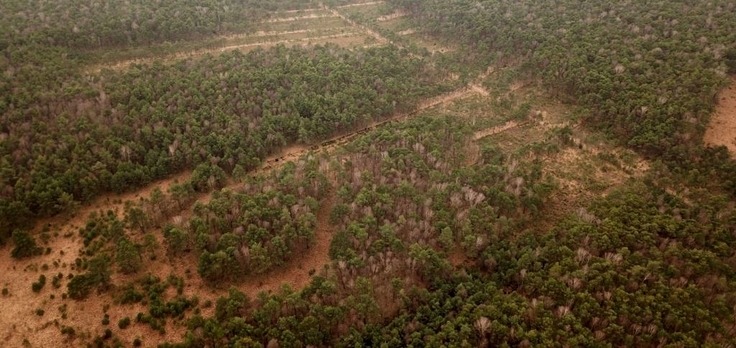
The Altwarmbüchen Moor offers great potential for creating the conditions for sustainable peatland development.
The three sub-areas of Altwarmbüchen Moor, Rehburger Moor and Trunnenmoor are not only nature reserves under national law, but also enjoy Europe-wide protection status as part of the Natura 2000 network of protected areas. The main objective of the project is to implement area-specific management plans for the conservation and development of protected species and habitats under the Fauna-Flora-Habitat Directive (see management plans for Altwarmbüchener Moor, Rehburger Moor and Trunnenmoor).
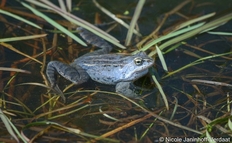
The three peatlands were drained over many decades. Many of these drainage structures are still effective today. Therefore, restoring near-natural moor water levels through rainwater retention is a top priority in order to create the conditions for sustainable peatland development. Outside the peatland areas, additional selective measures for amphibian protection are being implemented. The focus here is on the species protected under the Habitats Directive: the crested newt, moor frog and common spadefoot toad.
The Ministry of the Environment is once again primarily responsible for the project. The NLWKN will manage and implement the project in cooperation with the Hanover region. Three land consolidation procedures are planned to accompany the project in order to make the land available. The Office for Regional Development (ArL) Leine-Weser is in charge of this.
 Bildrechte: NLWKN
Project background
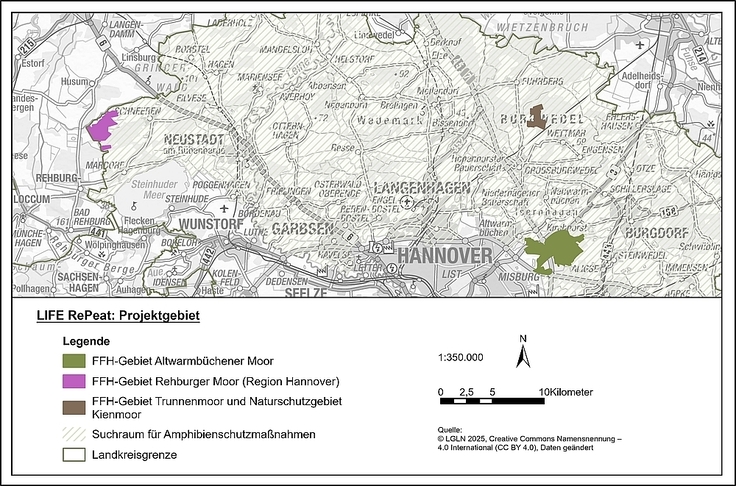
The project area for the restoration of near-natural moor water levels
- Total area: 1,840 ha
- Sub-area 1 - Altwarmbüchener Moor
Area: 1.226 ha
Protection status: FFH area, nature reserve HA 044 Altwarmbüchener Moor (protected area ordinance) - Sub-area 2 - Rehburger Moor
Area: 447 ha
Protection status: FFH area, 198 ha nature reserve HA 114 Bieförthmoor (protected area ordinance), 249 ha landscape conservation area H 002 Schneerener Berg – Eisenberg (protected area ordinance) - Sub-area 3 - Trunnenmoor
Area: 171 ha
Protection status: FFH area and nature reserve HA 047 Trunnen Moor (protected area ordinance) - FFH habitat types: Area: 725 ha, including: Moor forests, drained raised bogs, open raised bogs, nutrient-poor standing waters, cutting bogs
- Current greenhouse gas emissions: approx. 41,500 t CO2 eq/a
 Bildrechte: O. v. Drachenfels
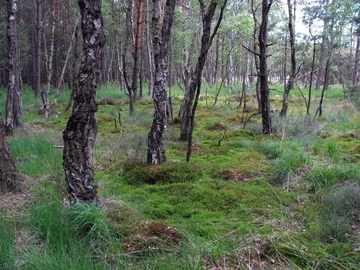
Birch and pine bog forest in the Altwarmbüchener Moor
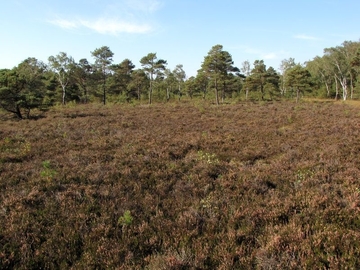 Bildrechte: O. v. Drachenfels
Common heather in the Rehburger Moor
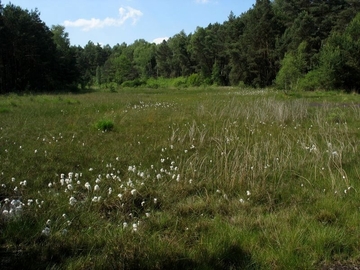 Bildrechte: O. v. Drachenfels
Transition mire with cotton grass and sphagnum moss in the Trunnenmoor
Why should peatlands be wet?
‘Peatlands are superheroes’ when they are wet enough for sphagnum mosses to grow and bind CO2 in the long term. Water levels between 5 and 10 cm below the ground surface are optimal for this. If these levels are maintained in the long term, moors can not only make a major contribution to species and biotope protection and climate protection, but also contribute significantly to groundwater recharge and flood protection.
Large parts of the Altwarmbüchener Moor, the Rehburger Moor and also the Trunnenmoor have been drained over many decades for peat extraction or for agricultural and forestry use. This has led to the drying out and mineralisation of the peat and thus to increased CO2 emissions. Protected species typical of moors and their habitats have continued to decline in number. This threatens the disappearance of species and habitats protected by the European Fauna-Flora-Habitat Directive (FFH-RL). Active measures are now being taken to counteract this process.
Lower Saxony bears a special responsibility for the highly endangered moor ecosystem, as it is home to most of Germany's raised bogs. Management plans for the three FFH areas are already available from 2021 (see Management plans for the Hanover region (PDF) for Altwarmbüchener Moor, Rehburger Moor and Trunnenmoor). These plans not only set out binding conservation and development goals for each FFH area, but also initial proposals for measures to achieve these goals. However, the management plans need to be refined and, above all, tailored to local interests and constraints in order to enable concrete planning for peatland renaturation.
- General questions: Thomas Kutter (NLWKN), email to Thomas Kutter , tel: 0511/3034-3352
- Contact for landowners interested in selling:
1) Private sale:
- Altwarmbüchener Moor: Thomas Krüger (NLWKN), email to Thomas Krüger , tel: 0511/3034-3358
- Rehburger Moor: Marcel Hollenbach (Hanover Region), email to Marcel Hollenbach, tel: 0511/616-23958
- Trunnenmoor: Thomas Krüger (NLWKN), email to Thomas Krüger , tel: 0511/3034-3358
2) Land consolidation procedure
- Dirk Niemann (ArL Leine-Weser), email to Dirk Niemann, tel: 05121/6970-153
- Jennifer Weiß (ArL Leine-Weser), email to Jennifer Weiß, tel: 05121/6970-163
Bildrechte: NLWKN
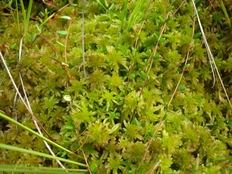 Bildrechte: S. Brosch
Sphagnum moss and cranberry (Image rights: S. Brosch)
Further information about the project
is available from the Hanover Region and the Hannover Regional Development Office (ArL)
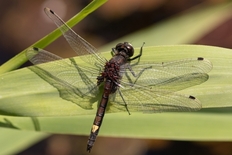 Bildrechte: N. Janinhoff-Verdaat
White-faced darter (Leucorrhinia pectoralis) (Image rights: N. Janinhoff-Verdaat)
Information about the FFH areas
 Bildrechte: LK Nienburg
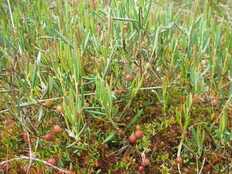
bog-rosemary, cranberry (Image rights: LK Nienburg)
 Bildrechte: N. Janinhoff-Verdaat
Moor frog (Image rights: N. Janinhoff-Verdaat)
 Bildrechte: S. Brosch
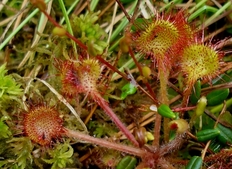
Round-leaved sundew (Image rights: S. Brosch)
 Bildrechte: NLWKN
Artikel-Informationen
Ansprechpartner/in:
Thomas Kutter
Nds. Landesbetrieb für Wasserwirtschaft, Küsten- und Naturschutz
Betriebsstelle Hannover-Hildesheim
Göttinger Chaussee 76 A
D-30453 Hannover
Tel: +49 (0)511 / 3034-3352